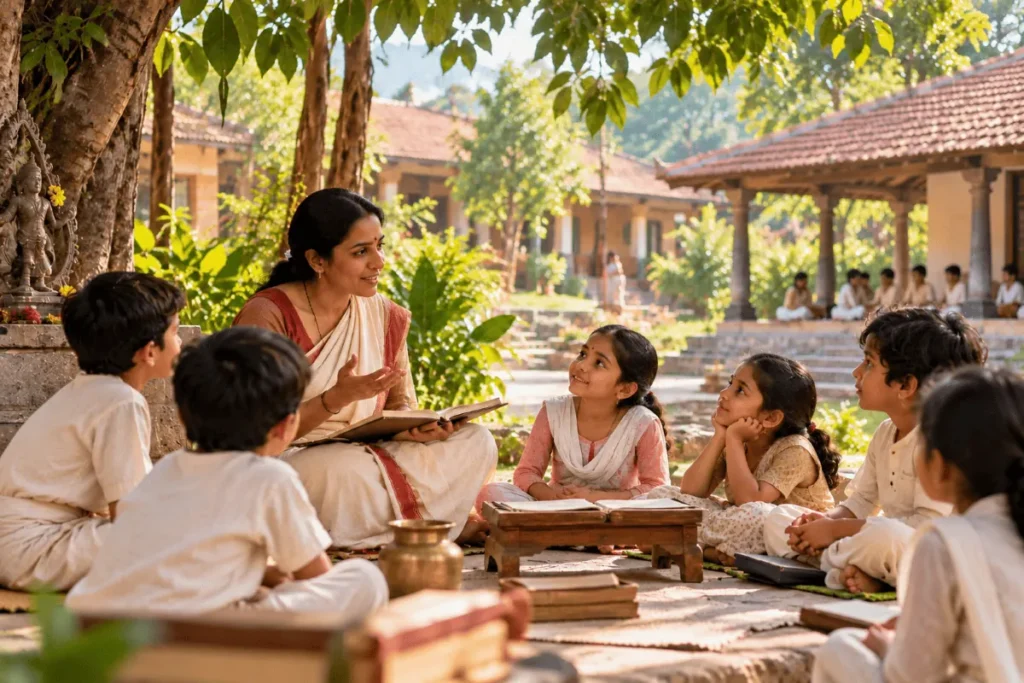
The importance spirituality in early childhood education lies, fundamentally, in its potential to broaden the very purpose of learning. And its significance becomes more clear when we view it through the principles of the Bharatiya Gyan Parampara (Indian Knowledge Traditions).
For well over 3,500 years, the Bharatiya Gyan Parampara for holistic development has long placed the development of an individual – beyond just the acquisition of academic knowledge.
World-Renowned Indian Spiritual Leaders’ Thoughts On Spiritual Education
Sri Aurobindo placed spiritual development within their broader philosophy of integral education.
Swami Vivekananda emphasised character formation and the development of inner potential.
Swami Chinmayananda connected spiritual growth with cultural understanding and universal values.
While their perspectives may not be the same, they do commonly share one critical idea:
Education should support the development of an individual – as a whole, rather than focus exclusively on academic performance.
This common and shared approach also explains why spiritual development should not be confined as a separate subject or an occasional classroom activity. Rather, during their early childhood years, children can begin developing empathy by helping others, responsibility by caring for their surroundings, and discernment by discussing the choices made by characters in stories.
| Leading Spiritual Leaders’ Shared Theme | What it Means in Education |
|---|---|
| Holistic Child Development | Academic learning should form part of a wider process of human development. |
| Early Value Formation | Adults should model the behaviour and values they wish children to learn. |
| Inner Awareness | Children should gradually develop self-awareness, discernment, and control over their actions. |
| Learning Through Stories and Culture | Stories, songs, art, games and local traditions offer age-appropriate ways to introduce values. |
| Compassion and Service | Children should learn to care for others and contribute to their communities. |
| Family and Teachers’ Influence | A child’s learning environment includes the home, relationships, and adult behaviour. |
| Wider Connection and Responsibility | Education should develop concern for others, nature, and society |
As they grow older, say around the 11 to 13 years, teachers can introduce deeper discussions about ethical decisions, personal values, duty, and social responsibility. These discussions should match each child’s age and the stage of development.
Education should support the development of an individual – as a whole, rather than focus exclusively on academic performance.
Spiritual development, in this context, concerns how children understand themselves, relate to others, make choices, and most critical of all, demonstrate their values in everyday life.
In fact, India’s National Curriculum Framework for the Foundational Stage 2022 and National Curriculum Framework for School Education 2023 also emphasise the importance of spiritual intelligence in education.
The frameworks support holistic development and recognise the relevance of Indian philosophical traditions to contemporary learning. Their emphasis on the child’s overall development provides a strong basis for examining how spiritual and ethical dimensions can complement growth across key developmental domains, viz. intellectual, physical, social, and emotional.
Spirituality in Early Childhood Education: From Theory to Practice
The gyan parampara (knowledge tradition) recognises that inner awareness, values, character, discernment, compassion, and responsible conduct are not only essential, but fundamental part of education.
In line with that parampara, concepts such as Panchakosha Vikas, Samskara, Viveka, Dharma, Seva, Atma Vichara, Karuna and Ahimsa, and Vasudaiva Kutumbakam offer different perspectives on how these qualities can be developed through education right from an early years of a child.
These concepts can also be looked at as some of the examples of spiritual development in early childhood.
| Bharatiya Gyan Parampara Concept | Meaning in Education | Relevance to Children |
|---|---|---|
| Samskara | Habits, Values and Dispositions shaped through upbringing and experiences. | Focuses the attention on the influence of parents, teachers, daily routines, and role models. |
| Viveka | The capacity to discern and make considered/well-informed judgements. | Supports age-appropriate discussions about right and wrong, fairness, honesty, and responsibility. |
| Dharma | Right conduct, duty, and responsibility in a given context. | Connects personal behaviour with responsibilities towards others and community. |
| Seva | Service and helpful action for others | Gives children practical ways to express care, cooperation, and social responsibility. |
| Atma-Vichara | Inquiry into oneself and one’s inner nature. | Provides a philosophical basis for age-appropriate self-awareness and reflection. |
| Karuna and Ahimsa | Compassion and non-voilence. | Offer principles for respectful relationships, empathy, and peaceful conflict resolution. |
| Vasudaiva Kutumbakam | The idea of: The World is One Family | Supports concern for people, living beings, and the wider world. |
Together, these concepts provide a framework for understanding education as a process that shapes how a child thinks, feels, behaves, relate to others, and most of all – understand his/her responsibilities!
Children Learn What They See.
These concepts are particularly relevant during early childhood, since children learn what they see! They learn – extensively, through observation, imitation, relationships, stories, play, and their everyday experiences.
Conclusion
From the Indian Knowledge Tradition (Bharatiya Gyan Parampara) perspective, spirituality in early childhood education should therefore attend to both what children learn and the qualities they develop – as they grow. This approach is particularly significant during the early childhood years, when a child’s everyday experiences help shape her/his foundations for learning at a later phase in life, relationships, conduct and behaviour.
While academic knowledge equips children to understand information and solve problems, it is the development of inner awareness, sound judgment, compassion, and responsibility that can help them apply that knowledge thoughtfully and consciously in their lives.