
Imagine this: New Year’s eve is here, and you’re at a popular mall with your kids. You turn around for a moment, and your child is no longer beside you! While not every parent would’ve experienced this, knowing how to prevent your child from getting lost starts with keeping them close, staying alert and setting and following simple rules before you leave home.
Malls, parks, beaches, markets and public events can create many moments for a child to move out of sight. You can reduce the chance of separation – significantly, by planning ahead and knowing where closer supervision matters most.
So here are some simple, yet powerful and practical steps parents and families can take to keep children safe during public outings.
Table of Contents
5 Ways To Prevent Your Child from Getting Lost in Public
Here’s how to prevent kids from getting lost:
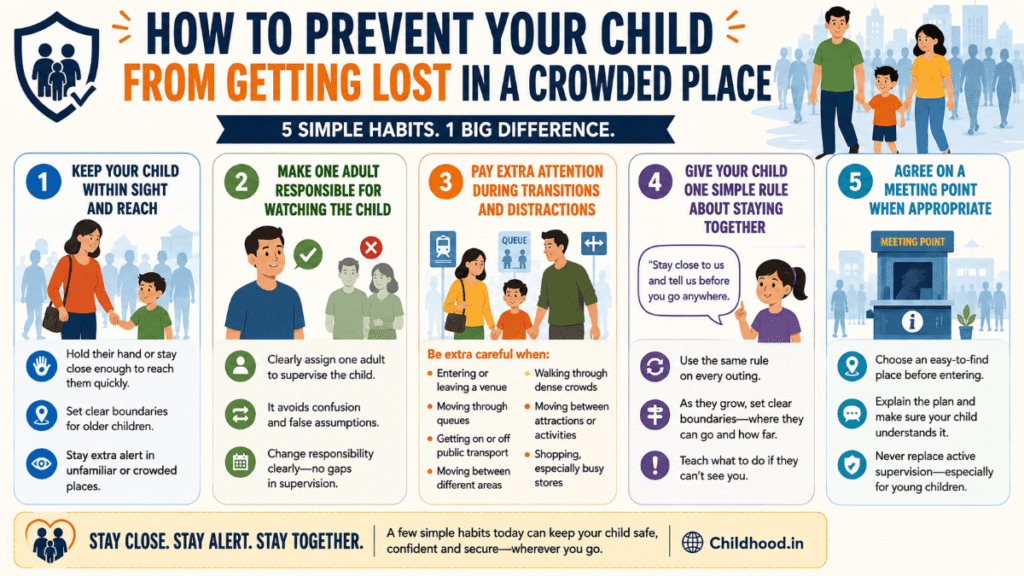
1. Keep Your Child Within Sight and Reach
First things first, keep younger children close to you in crowded public places. Hold their hand or stay close enough to reach them quickly.
Older children may need more freedom, but they still need clear boundaries. Tell them how far they can move away from you, and where they can go.
Give closer attention when you enter an unfamiliar or very crowded place. A child can move out of sight quickly when many people are moving around.
2. Make One Adult Responsible for Watching the Child
Several adults can create a false sense that someone is watching the child. Each person may assume that another adult has their eyes on the child.
Avoid this by clearly assigning responsibility. One adult should know that they are responsible for watching the child at that time.
You can change this responsibility during the outing. Make the change clear so there is no gap in supervision.
3. Pay Extra Attention During Transitions and Distractions
Some moments create a higher chance of separation, as families often move, stop and change direction quickly during these moments.
Pay particular attention when:
- Entering or leaving a venue.
- Moving through queues.
- Getting on or off public transport.
- Moving between different areas.
- Walking through dense crowds.
- Moving between attractions or activities.
- Shopping, especially food, electronics and consumer durables.
Make sure to keep your child close during these moments. Do not rely on general supervision when the family is moving, or when attention is divided.
4. Give Your Child One Simple Rule About Staying Together
Children need a rule that they can remember easily. Tell your child to stay with the family and tell you before moving away.
For a younger child, you could say:
“Stay close to us and tell us before you go anywhere.”
Use the same rule during different outings. Repetition helps the child understand what you expect.As children become older, you can give them clearer boundaries.
They can learn where they may go, how far they may move, and what they should do if they cannot see you.
5. Agree On a Meeting Point When Appropriate
A meeting point can help older children who understand the plan, and can reach the location safely. Choose a place that is easy to identify before entering a large venue.
For example, a family might choose the main information desk at a mall or a clearly marked entrance.
Explain the plan to the child before the outing. Make sure they understand where the meeting point is and when they should use it.
Remember however, that a meeting point should never replace active supervision. Young children may not be able to reach it safely on their own, so staying close to a responsible adult remains the priority.
Prepare Together Before You Go Out
Keeping your child close is the first line of prevention. Your child should also know what to do if you become separated during an outing.
The preparation should be simple enough for your child to remember, and use it with absolute clarity and zero confusion!
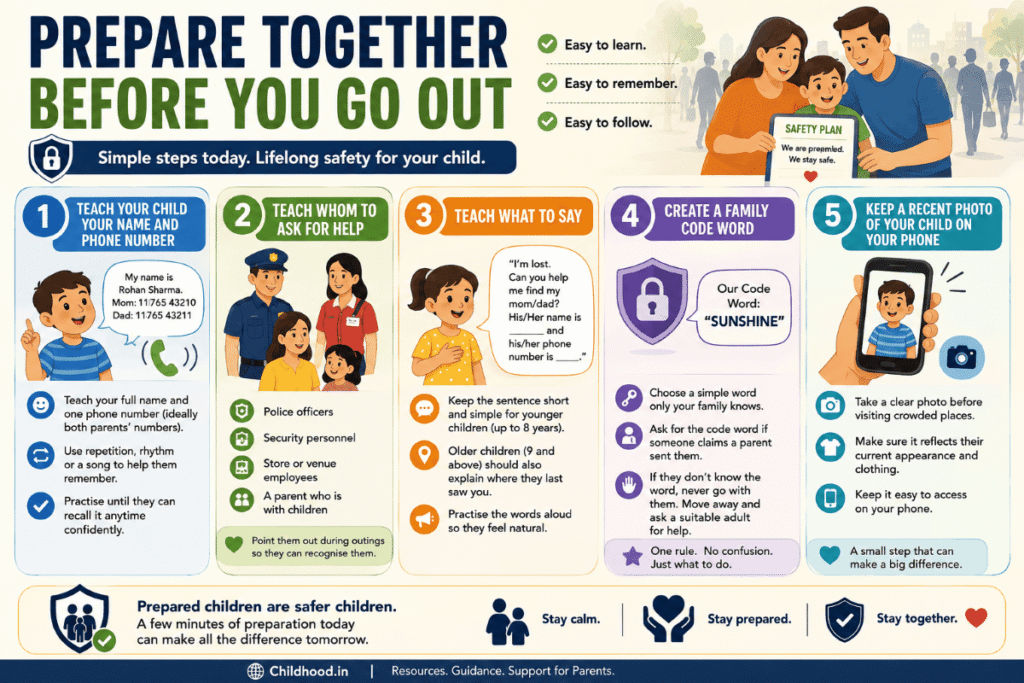
a) Teach Your Child Your Name and Phone Number
Make sure your child knows your full name and your one phone number. Ideally, they should know the numbers of their mom and dad. This information can help a suitable adult contact you if your child becomes separated from you.
Younger children may need regular practice. Use repetition, rhythm or a simple song makes it easier for them to remember. Make them practise until they can recall it comfortably, and can say it at any random point when asked for.
b) Teach Whom to Ask for Help
One of the most important things to teach your child about what they should do if they get lost is whom they can approach for help.
Teach them to look for:
- Police officers.
- Security personnel.
- Store or venue employees.
- A parent who is with children.
When it comes to what should a child do if they get lost, there’s nothing more critical than knowing whom to approach for help!
Make sure to point at these people out during normal outings. This helps your child recognise them before they ever need their help.
Also explain that asking a suitable adult for help is absolutely okay – if they become separated from you.
c) Teach What to Say
Give your child a short sentence to practise:
“I’m lost. Can you help me find my mom/dad? His/Her name is ___ and his/her phone number is ___.”
Keep the sentence simple for younger children (up to 8 years). If you have older children (9 and above) teach them to also explain where they last saw you.
Practise the words aloud. Your child should feel comfortable saying them without having to think about what to say.
d) Create a Family Code Word
Choose a simple word that only your family knows. Teach your child to ask for this word if someone claims that a parent sent them.
If the person does not know the code word, your child should never leave with them! Teach the child to move away and ask a suitable adult for help instead.
Make sure the rule should stay simple, so your child does not need to decide whether someone is trustworthy. They just need to only remember what to do. Period!
f) Keep a Recent Photo of Your Child on Your Phone
Take a clear photo of your child before visiting a crowded public place. A recent photo can help you give venue staff an accurate description if you need assistance.
Make sure the photo reflects your child’s current appearance and clothing. Keep it easy to access on your phone.
The 5-Step Framework: Teach Your Child What to Do If You Become Separated
Teaching this 5-Step Framework to your child, so they know know exactly what to do if they get separated. The framework is simple to teach for you, and easy to understand for your child.
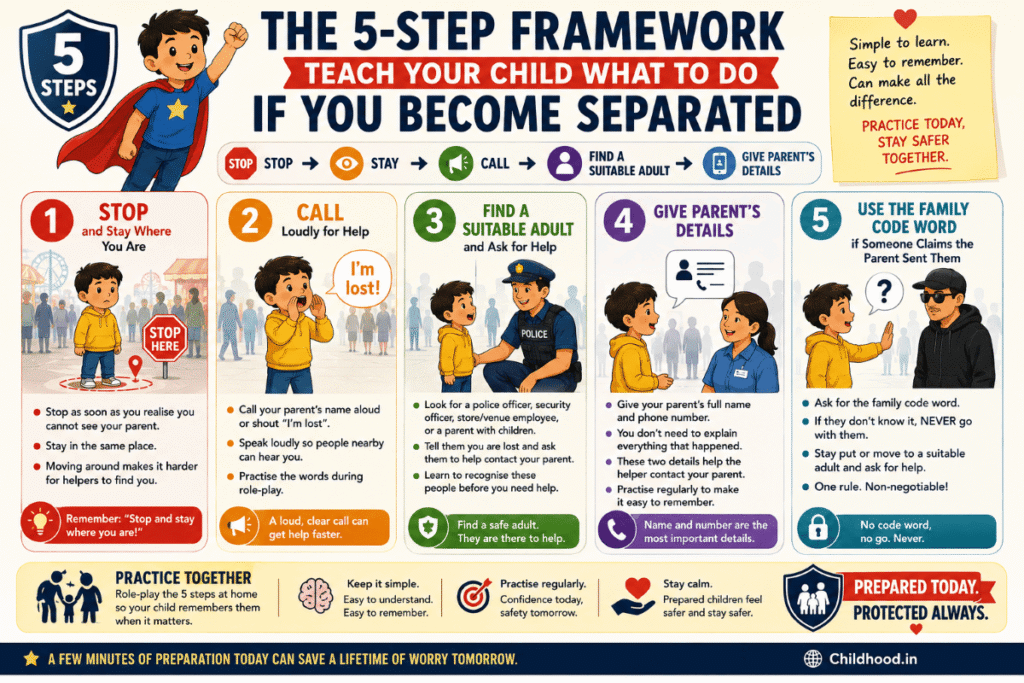
Here’s the 5-Step Framework – in a nutshell:
Stop → Stay → Call → Find A Suitable Adult → Give Parent’s Details
Now let’s look at each one of them in detail.
Step 1: Stop and Stay Where You Are
Teach your child to stop as soon as they realise they cannot see you. They should stay in the same place instead of walking around to look for you.
Staying in one place gives you and other helpers a fixed area to search. Moving around can make it harder to find the child.
For younger children, keep the instruction simple:
“Stop and stay where you are!”
Step 2: Call Loudly for Help
After stopping, your child should call your name aloud, or shout:
“I’m lost.”
Teach them to speak loudly enough for people nearby to hear them. A clear call can help a parent, security officer or other suitable adult notice the child.
Practise the words during role-play so your child knows exactly what to say.
Step 3: Find a Suitable Adult and Ask For Help
Your child should then approach someone who can help. Remind them to look for a police officer, security officer, store or venue employee, or a parent who is with children.
The child should explain that they are lost and ask the person to help contact their parent.
This is why children should learn to recognise these people before they need help.
Step 4: Give Parent’s Details
Teach your child to give the parent’s full name and phone number when asking for help.
The child does not need to explain everything that happened. Knowing these two details gives the helper useful information to contact the parent.
Regular practice can make this information easier for the child to recall.
Step 5 – Use The Family Code Word if Someone Claims the Parent Sent Them
Teach your child to ask for the family code word if someone says that a parent sent them. The code can be anything that’s simple and easy for all of you can remember.
It can be any one of your pet-name that’s used at home, the name of your actual pet, a favourite ice cream flavour all of you like, or even the child’s full date of birth.
Simply put, just use your imagination!
If the person does not know the correct code word, the child should never leave with them – no matter what! The child should stay put where they are, or move towards a suitable adult and ask for help.
Keep this rule simple and non-negotiable! The child only needs to remember the action, not decide whether the person is trustworthy.
Now that you know what to tell your child to do if they get lost, it also becomes important that you acknowledge them when they memorise the 5-Step framework, with genuine praise and encouragement.
What Parents Should Do If They Cannot Find Their Child?
If you realise that your child is no longer with you, here’s the first and foremost thing that you need to do as a responsible parent: Stay Calm!
Do not panic. Take a few deep breaths and collect yourself together. Be aware that being anxious is not going to help you make the right next-steps.
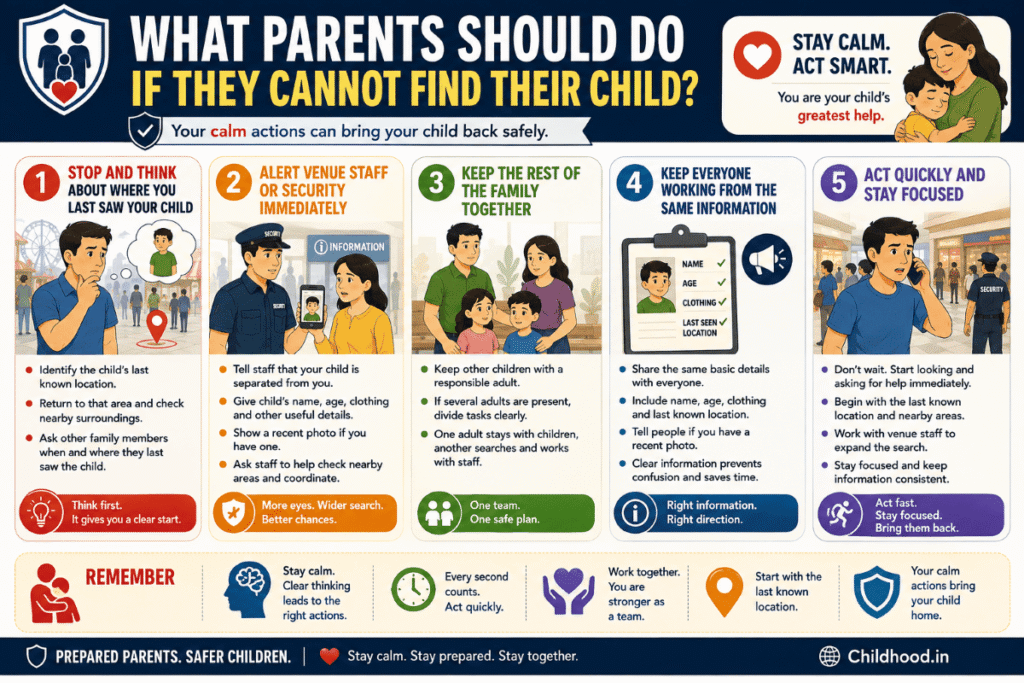
a) Stop and Think About Where You Last Saw Your Child
Before moving around the venue, identify the child’s last known location. Return to that area and check the nearby surroundings carefully. Ask other family members when and where they last saw the child. This can give you a clearer starting point if you did not see the separation happen.
b) Alert Venue Staff or Security Immediately
Tell a security officer, employee or other responsible venue staff member that your child has become separated from you.
Give them the child’s name, age, clothing and other useful details. Show them a recent photo on your phone if you have one.
Ask staff to help check the nearby areas and coordinate with other employees. A venue team can often help cover several areas while you continue the search.
c) Keep the Rest of the Family Together
If you have other children with you, keep them with a responsible adult while the search continues.
If several adults are present, divide the tasks clearly. One adult can stay with the other children while another works with venue staff or checks the child’s last known location.
This prevents another child from becoming separated while everyone is focused on the search.
d) Keep Everyone Working From The Same Information
Give each person the same basic description of the child. Include the child’s name, age, clothing and last known location.
Tell people if the child has a recent photo on your phone. Clear information helps family members and venue staff search the same areas without confusion.
e) Act Quickly and Stay Focused
Do not wait for your child to find the family on their own. Start looking and ask for help as soon as you realise the child is missing from your immediate view.
Begin with the last known location and nearby areas. Then work with venue staff to extend the search while keeping the information consistent.
Closing Thoughts
A child does not need a long list of safety instructions to stay safer during a family outing. They just need to remember the 5-Step Framework, understand its importance, and diligently follow it.
As parents, how to prevent your child from getting lost is as important as your child knowing what to do if they get separated in a public place. And that’s why remembering the above steps and tips can help your family enjoy public places together with greater confidence.
Most of all, it can give you peace of mind!
Frequently Asked Questions
What is the best way to prevent your child from getting lost in a crowded place?
Keep your child close, assign clear supervision to an adult, and teach your child simple rules for staying with the family. Also emphasise its importance.
How can I teach my child to stay with me in crowded places?
Set one simple rule, such as staying within sight and telling you before moving away, and repeat it consistently during outings. Over time, it will become second nature for them.
Should my child know my phone number in case we get separated?
Yes. Teach your child your full name and at least one phone number, then practise the information until they can recall it easily. Ideally of course, they should know the numbers of both parents.
Who should my child ask for help if they cannot find me?
Teach your child to approach a police officer, security officer, venue employee, or a parent who is with children. Also emphasise that they shouldn’t go too far away from where they are.
What should my child do first if they cannot see me in a crowded place?
They need to just diligently follow this 5-Step Framework (discussed above):
Stop → Stay → Call → Find A Suitable Adult → Give Parent’s Details
How can I prepare my child for the possibility of getting separated?
Practise the response through calm role-play, teach your child whom to approach, and use a simple family code word as part of the plan. As the saying goes: Prevention is better than cure.