
The impact of celebrity endorsement on child behaviour is a growing concern for parents, teachers, and caregivers. Children spend a significant part of their day consuming media, where they regularly encounter celebrities promoting snacks, sugary drinks, and packaged food products. While many adults view these advertisements as harmless marketing, children often interpret them very differently.
From an early age, children learn by observing and imitating the people they admire. Traditionally, these role models included parents, teachers, siblings, and community members. Today, celebrities, athletes, influencers, and digital personalities also shape children’s attitudes, preferences, and everyday choices.
Research suggests that celebrity endorsements can influence what children want, what they ask for, and even what they choose to eat. In some cases, the effect can continue long after the advertisement has ended. This is particularly important during the early years, when children are still developing the ability to recognise persuasive marketing and make independent judgments.
In this article, we will examine what scientific research says about celebrity influence on children, why young minds are especially susceptible to these messages, and what parents and teachers can do to help children make informed choices regardless of who endorses a product.
Table of Contents
How Child Behaviour Develops Through Observation and Imitation?
Psychologist Albert Bandura helped explain this process through Social Learning Theory. His research showed that children often learn behaviours by observing others rather than through direct instruction alone. In simple terms, children tend to copy people they admire, trust, or view as successful. The influence of a role model can shape behaviour even when no one explicitly tells a child what to do.
For most children, parents, caregivers, and teachers remain the most influential role models. However, modern media has expanded the list. Today, children also spend time watching actors, athletes, influencers, and online personalities. Many of these individuals become familiar faces long before a child fully understands advertising or marketing.
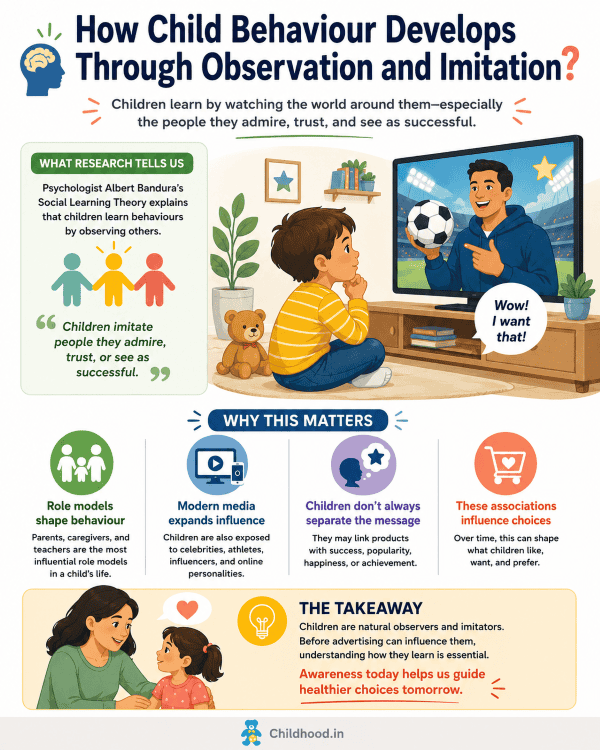
This matters because children do not always separate the person from the message. When a favourite celebrity repeatedly appears alongside a product, children may begin to associate that product with success, popularity, happiness, or achievement. Over time, these associations can influence their preferences and choices.
Understanding this natural tendency to observe and imitate is the first step in understanding why celebrity endorsements can affect child behaviour. The influence does not begin with advertising. It begins with how children learn.
What Is Celebrity Endorsement and Why Does It Influence Children?
Celebrity endorsement occurs when a well-known person promotes a product, service, or brand. Companies use celebrities because people tend to recognise them, trust them, and pay attention to them. A familiar face can make a product appear more attractive than it might otherwise seem.
For adults, a celebrity endorsement is usually one factor among many when making a purchase decision. Adults can compare products, read labels, consider health implications, and evaluate marketing claims. Children, however, process these messages differently.
Young children often focus on the person rather than the product. If they admire a celebrity, they may assume that the product being promoted is good, desirable, or worth trying. They may not realise that the celebrity is being paid to promote the product. As a result, the endorsement can feel more like a recommendation than an advertisement.
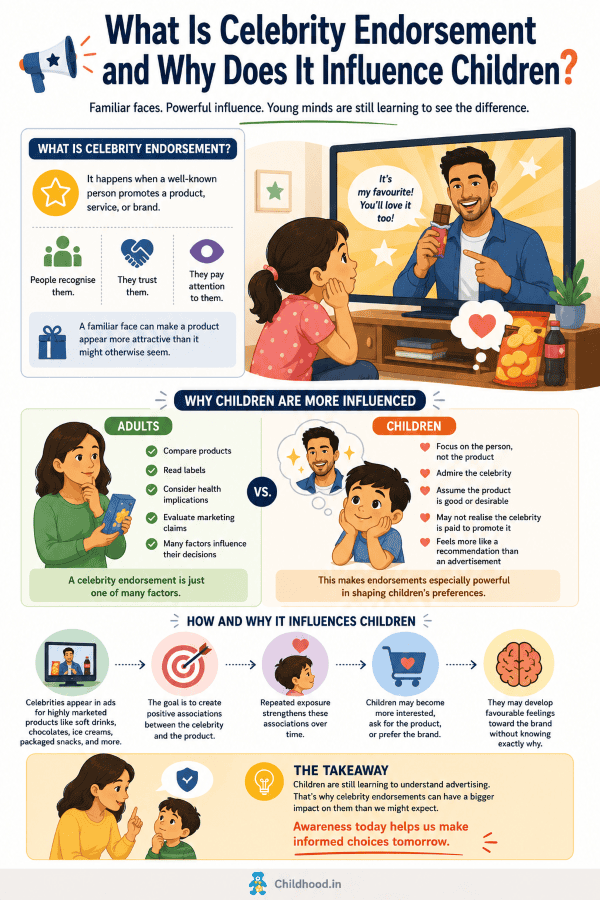
Food and beverage companies understand this influence well. That is why celebrities frequently appear in advertisements for soft drinks, chocolates, ice creams, packaged snacks, and other highly marketed products. The goal is not simply to create awareness. The goal is to create positive associations between the celebrity and the product.
Over time, repeated exposure can strengthen these associations. A child who regularly sees a favourite actor or athlete promoting a product may become more interested in trying it. They may request it during shopping trips or develop favourable feelings toward the brand without knowing exactly why.
This does not mean every celebrity endorsement will influence every child in the same way. However, it helps explain why researchers have spent years studying the relationship between celebrity marketing and child behaviour.
How Celebrity Endorsements Can Affect Child Behaviour?
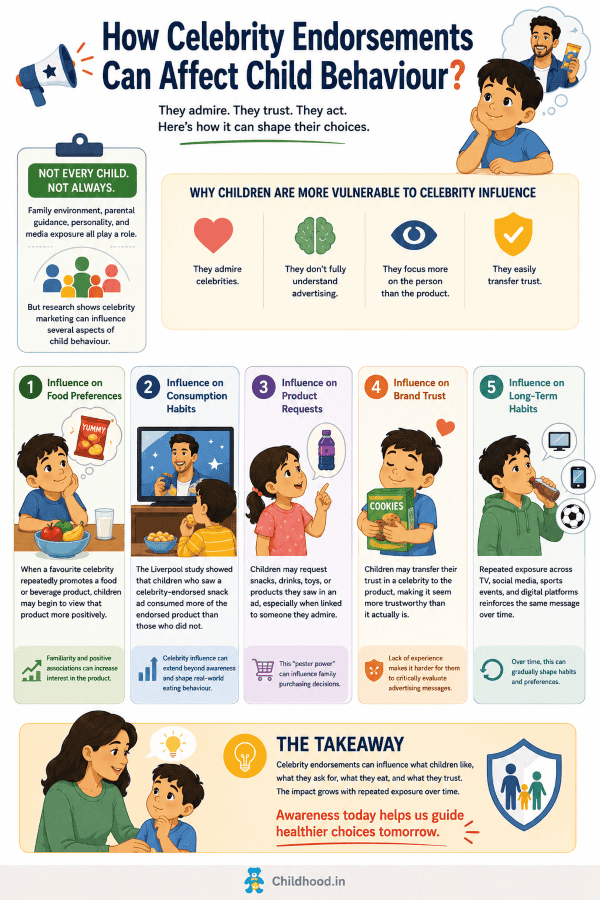
Celebrity endorsements do not influence every child in the same way. Family environment, parental guidance, personality, and media exposure all play a role. However, research suggests that celebrity marketing can affect several aspects of child behaviour.
1. Influence on Food Preferences
Children often develop preferences long before they understand nutrition. When a favourite celebrity repeatedly promotes a food or beverage product, children may begin to view that product more positively. Over time, familiarity and positive associations can increase interest in the product.
2. Influence on Consumption Habits
The Liverpool study demonstrated that celebrity endorsements can affect actual eating behaviour. Children who saw a celebrity-endorsed snack advertisement consumed more of the endorsed product than those who did not.This finding suggests that celebrity influence can extend beyond awareness and shape real-world choices.
3. Influence on Product Requests
Many parents have experienced children requesting a specific snack, drink, toy, or product they recently saw in an advertisement. Celebrity endorsements can strengthen these requests because children may associate the product with someone they admire. This phenomenon is sometimes referred to as “pester power,” where repeated requests influence family purchasing decisions.
4. Influence on Brand Trust
Children often lack the experience needed to critically evaluate advertising messages. As a result, they may transfer their trust in a celebrity to the product being advertised. A familiar and well-liked celebrity can make a product appear more trustworthy than it actually is.
5. Influence on Long-Term Habits
Repeated exposure to celebrity-endorsed products can gradually shape habits and preferences. A single advertisement may have limited impact. However, repeated exposure across television, social media, sports events, and digital platforms can reinforce the same message over time.
What Research Says About Celebrity Endorsements and Children’s Behaviour?
Many parents assume that celebrity endorsements simply help companies increase brand awareness. However, researchers have found that these endorsements can do much more than make a product memorable. They can influence children’s real-world behaviour.
Research Study 1
One of the most widely cited studies on this topic was conducted by researchers at the University of Liverpool, led by Emma Boyland. The study involved children between the ages of 8 and 11. Researchers wanted to understand whether celebrity endorsements could influence how much children consumed of a food product.
The findings were striking. Children who watched a snack advertisement featuring a well-known sports celebrity consumed significantly more of the endorsed snack than children who did not see the celebrity endorsement. In other words, the endorsement did not simply affect awareness or attitudes. It influenced actual eating behaviour.
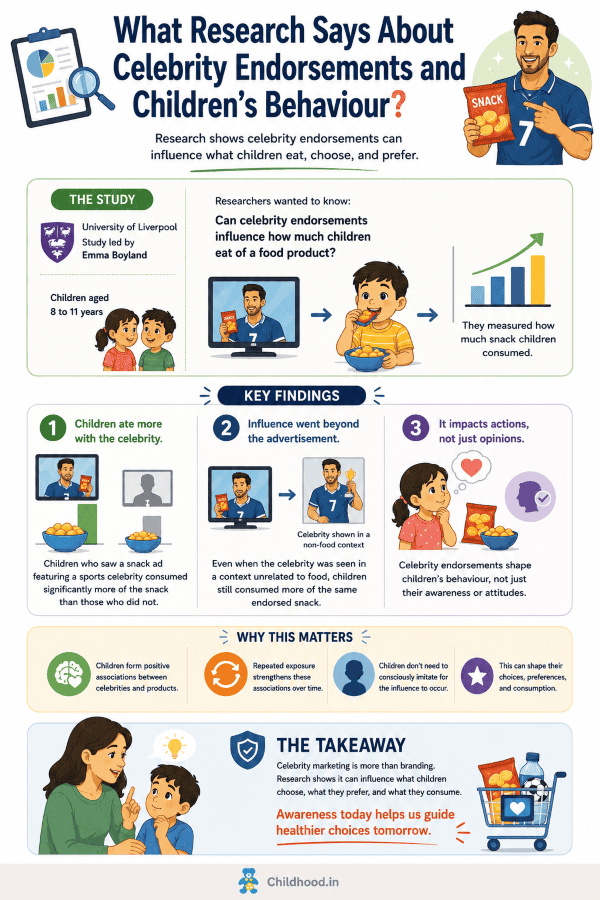
The researchers also made another important discovery. Some children later saw the same celebrity in a context unrelated to food advertising. Even then, they consumed more of the endorsed snack. This suggested that the influence extended beyond the advertisement itself. The celebrity had become mentally associated with the product.
These findings matter because they show that celebrity endorsements can affect children’s actions, not just their opinions. A child does not need to consciously decide to imitate a celebrity for the influence to occur. Repeated exposure can create positive associations that shape behaviour over time.
For parents and teachers, the key takeaway is simple. Celebrity marketing is not merely a branding exercise. Research suggests that it can influence what children choose, what they prefer, and what they consume. This is one reason why many researchers and public health experts continue to study the impact of celebrity endorsements on child behaviour.
The Liverpool study is important because it demonstrates a direct link between celebrity endorsements and children’s eating behaviour. However, researchers have continued to investigate whether this effect appears across different settings, products, and age groups.
Research Study 2
A systematic review published in 2022 examined the broader body of research on celebrities, influencers, and food marketing aimed at children. Instead of focusing on a single experiment, the review analysed findings from multiple studies. This allowed researchers to identify patterns that appeared consistently across the evidence.
The review found that celebrity and influencer marketing often affected children’s attitudes toward food products. Children generally showed stronger preferences for products promoted by familiar public figures. They were also more likely to express interest in trying or requesting those products.
Researchers observed another recurring pattern. Marketing campaigns that featured celebrities often increased children’s positive perceptions of the advertised products. In many cases, children viewed the products more favourably even when the nutritional quality of those products was poor.
Importantly, many of the products examined in these studies were high in sugar, salt, or unhealthy fats. These are the same types of products that frequently dominate celebrity advertising campaigns aimed at younger audiences. As a result, researchers have raised concerns about the role of celebrity marketing in shaping children’s food preferences and consumption habits.
Taken together, the evidence points in a similar direction. Celebrity endorsements can influence how children think about food, what they want to consume, and which products they view positively. While many factors contribute to children’s eating habits, research suggests that celebrity marketing is one influence that parents and educators should not ignore.
What Parents, Teachers, and Caregivers Can Do?
Parents, teachers, and caregivers cannot control every advertisement a child sees. However, they can help children develop healthier habits and make better decisions when they encounter marketing messages.
Here’s what they should do:
a) Evaluate Products Independently of Celebrity Endorsements
A celebrity’s popularity does not determine a product’s quality. Before introducing a product to a child, consider its ingredients, nutritional value, and suitability rather than the person promoting it.
b) Read Labels Instead of Advertisements
Advertisements are designed to highlight the attractive aspects of a product. Product labels provide more useful information. Checking sugar content, ingredient lists, and nutritional information can help families make informed choices.
c) Talk to Children About Advertising
Many young children do not understand that advertisements are designed to persuade. Simple conversations can help them recognise that celebrities are often paid to promote products. This understanding can reduce the influence of marketing messages over time.
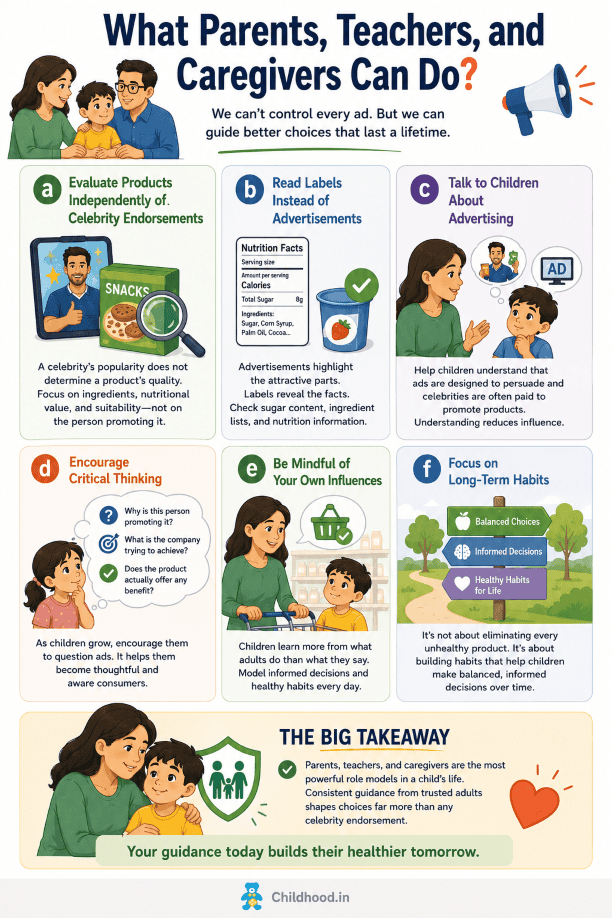
d) Encourage Critical Thinking
As children grow older, encourage them to ask questions about advertisements. Why is this person promoting the product? What is the company trying to achieve? Does the product actually offer any benefit? These questions can help children become more thoughtful consumers.
e) Be Mindful of Your Own Influences
Children often learn more from what adults do than from what adults say. If parents and caregivers make informed purchasing decisions, children are more likely to develop similar habits. Modelling healthy behaviour remains one of the most effective ways to influence a child’s choices.
f) Focus on Long-Term Habits
The goal is not to eliminate every unhealthy product or shield children from every advertisement. The goal is to help children develop habits that allow them to make balanced and informed decisions. Over time, these habits can become far more influential than any celebrity endorsement.
Parents, teachers, and caregivers remain the most powerful role models in a child’s life. While celebrities may capture attention, consistent guidance from trusted adults plays a much greater role in shaping long-term behaviour.
Real-World Examples of Celebrity Influence in Food and Beverage Marketing
Research helps us understand how celebrity endorsements influence children. Real-world examples show how these influences appear in everyday life.
One example that sparked considerable discussion in India involved actor Alia Bhatt. During a television appearance, she reportedly declined tea because it contained a small amount of sugar. Many viewers later pointed out that she had appeared in advertisements for products that contain far larger amounts of added sugar, including soft drinks, packaged beverages, chocolates, and snack foods.
The issue was not whether celebrities should consume these products themselves. The discussion centred on a different question. If public figures avoid certain ingredients in their personal lives, should parents automatically trust products simply because those same celebrities promote them?
This example highlights an important lesson. A celebrity endorsement does not necessarily reflect a celebrity’s personal consumption habits. Companies hire celebrities because they attract attention and help products reach wider audiences. The endorsement is a marketing arrangement, not a guarantee of quality or suitability.
Similar examples exist around the world. In many countries, celebrities have promoted sugary drinks, fast food products, confectionery items, and highly processed snacks. These products often receive extensive advertising exposure despite concerns about their nutritional value.
Researchers worry about this trend because children may focus more on the celebrity than on the product itself. A child may not evaluate sugar content, ingredient quality, or nutritional information. Instead, the child may remember that a favourite actor, athlete, or influencer appeared alongside the product.
Conclusion
The impact of celebrity endorsement on child behaviour deserves attention from parents, teachers, and caregivers. Research suggests that children can be influenced by the celebrities they admire, particularly when those celebrities promote sugary drinks, packaged snacks, and other highly marketed food products.
This influence may seem subtle, but repeated exposure can shape preferences, requests, and everyday choices over time. The good news is that adults remain the strongest influence in a child’s life. By looking beyond celebrity endorsements, evaluating products carefully, discussing advertising openly, and modelling healthy habits, parents and educators can help children make informed choices.
After all, a product’s value depends on what it contains and how it affects a child’s well-being, not on who appears in the advertisement.
Frequently Asked Questions
1. What is the impact of celebrity endorsement on child behaviour?
Celebrity endorsements can influence children’s preferences, product requests, and consumption habits. Children often associate admired celebrities with the products they promote.
Why are children more influenced by celebrity endorsements than adults?
Children have limited ability to recognize persuasive marketing techniques. They are also more likely to admire and imitate public figures they look up to.
At what age are children most vulnerable to celebrity influence?
Children between 0 and 8 years are generally the most impressionable because many core beliefs, habits, and behaviours develop during these years. Older children can also be influenced, but they often have stronger critical-thinking skills.
4. Can celebrity endorsements affect children’s eating habits?
Yes. Research has found that children may consume more of a food product after seeing it endorsed by a celebrity. The influence can extend beyond the advertisement itself.
5. Do celebrity endorsements only increase brand awareness?
No. Studies suggest that celebrity endorsements can influence actual behaviour, including product preferences, purchase requests, and consumption choices.
6. Are celebrity endorsements always harmful to children?
Not necessarily. The impact depends on the product, message, and how children interpret the endorsement, although concerns increase when unhealthy products are promoted.
7. How can parents reduce the influence of celebrity endorsements on children?
Parents can discuss advertising openly, encourage critical thinking, and evaluate products based on their quality rather than the celebrity promoting them.